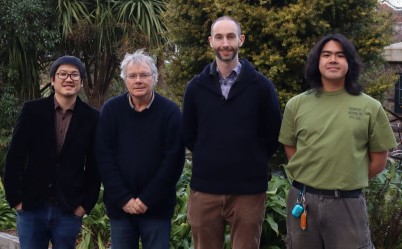
Newly funded research out of the University of Otago aims to combine the use of artificial intelligence (AI) with non-invasive measurements of brain activity to help clinicians more accurately assess cognitive capacity in New Zealand children with attention deficit hyperactivity disorder or ADHD.
Neuroscience researcher Dr Jack Scott has received a 2026 Explorer Grant from the Health Research Council of New Zealand (HRC) to carry out this research, one of 20 Explorer Grants announced today valued at a combined total of $3 million.
HRC Director of Investments Mr Stacey Pene says Explorer Grants are a great way to support researchers with innovative research ideas that have a good chance of making a revolutionary change to how we manage health in New Zealand.
“Many of these studies are researching new treatments and technology that could improve the effectiveness and efficiency of our healthcare system and developing new diagnostic and treatment tools, with the help of AI, in priority health areas for New Zealand such as cancer and children’s mental health,” says Mr Pene.
Dr Scott says ADHD affects about 5.8 percent of children in New Zealand1, with substantially higher rates of depression, substance abuse, and all-cause mortality in both childhood- and adult-diagnosed cases by middle age.
In February this year, the authority to assess and diagnose ADHD was expanded to include GPs and specialist nurses in response to an increased demand for diagnosis and long wait times. While a positive development, Dr Scott says this will likely take time to have an effect as extra training will be needed in many cases due to the complex nature of ADHD assessment and treatment.
“Clinicians rely on behavioural reports from parents and teachers, which are very valuable but subjective. Cognitive testing adds greater objectivity but can still be affected by how a child performs on the day. Performance can be modified by other factors such as anxiety, fatigue, and cultural alignment. We want to give clinicians a way to cross-reference both behavioural reports and cognitive assessment against brain wave patterns,” says Dr Scott.
Dr Scott and his team plan to develop a brain-based ADHD assessment tool using AI and electroencephalography (EEG), which measures brain activity through sensors placed on the scalp, to help clinicians better distinguish between a child’s underlying cognitive ability and their cognitive performance or how well they performed on the day of testing.
“We will extract specific brainwave patterns from neurotypical kids and kids with ADHD using EEG during cognitive tasks and at rest. This may better capture brain function independent of factors on the day, such as the rapport that the child has with the clinician, or test-taking factors such as how comfortable they are with the testing environment. We will also test if our tool can trace cognitive changes both on – and off – a child’s regularly prescribed medication.”
Dr Scott says that if successful, this tool could help clinicians gain a clearer picture of where an individual child’s cognitive strengths and difficulties lie, supporting targeted intervention before negative educational feedback loops compound into secondary health impacts.
Also, once clinicians have access to EEG equipment, recording costs about $30 in disposable materials per session plus technician costs. For ADHD, EEG compares favourably to other imaging techniques such as MRI at about $1,000 per scan, and EEG is easier to deploy in regional and rural settings.
Typically, machine learning requires massive datasets to be accurate, something that is difficult to achieve when recruiting from scratch in New Zealand’s research environment. To overcome this, Dr Scott and his team will adapt their AI models trained on international data to work accurately in New Zealand using small local samples, including groups typically underserved such as Māori and Pasifika.
“As the field of health-AI moves toward models trained on massive international datasets, New Zealand risks becoming a passive consumer of AI tools that underperform for our unique population,” says Dr Scott.
“We’re confident, however, that our novel methods will enable us to build the foundation of a model based on large existing international datasets and then ‘fine tune’ it to work accurately in a New Zealand context.”
Dr Scott says success would show New Zealand research teams that they can develop locally adapted AI tools from modest sample sizes, promoting efficiency in health research.
“In New Zealand, we’re trying to do things differently from the rest of the world. We want to create a unique approach to AI development and deployment that proves we can do worldclass AI here in New Zealand in a way that’s true to our values, and will benefit kids with ADHD, their parents, and the health system.”
You can find a full list of all the 2026 Explorer Grant recipients below. Please note that the HRC has approved one additional Explorer Grant, however, this is not listed below as the contract is still subject to negotiation.
1 New Zealand Health Survey Annual Data Explorer. (2025). Ministry of Health, New Zealand Health Survey 2024/2025. https://minhealthnz.shinyapps.io/nz-health-survey-2024-25-annual dataexplorer/_w_ba4009e16c6948508038d0d1a6261961/#!/explore-indicators
Recipients of the HRC’s 2026 Explorer Grants
Dr Divya Adhia, University of Otago
Rewiring risk: Catching pain in the act with early preventive neuromodulation
24 months, $150,000
Dr Snita Ahir-Knight, Dr Alexander Walker, University of Otago
Understanding clinical notes and co-writing from youth in mental health services
18 months, $150,000
Dr Christina Deng, University of Otago
Sprayable GLMO Mucoadhesive Gel for oral mucositis
18 months, $150,000
Dr Victoria Egli, University of Waikato
Digital epilepsy pathways: How digital and clinical inputs shape care
24 months, $150,000
Dr Ying Jin, Massey University
REST-Māmā restoring circadian sleep through technology-enhanced midwifery
24 months, $150,000
Dr Annette Lasham, Dr Nicholas Knowlton, The University of Auckland
Does the system “fit” women with lobular breast cancer? A national study
24 months, $150,000
Dr Ed Maunder, Auckland University of Technology
Identifying novel obesity treatments via the stress-adipose mobilisome axis
24 months, $150,000
Dr James Mbinta, Victoria University of Wellington, Research Trust
Adult vaccination: a novel approach to dementia prevention
24 months, $150,000
Dr David Musson, The University of Auckland
Mast cells as drivers and therapeutic targets of endometriosis
24 months, $150,000
Dr Pritika Narayan, University of Otago
From ethnicity to genotype: precision CAD risk in Aotearoa
24 months, $150,000
Associate Professor Daniel Pletzer, University of Otago
Do antimicrobial peptides work because of what they are, or where they come from
24 months, $150,000
Professor llva Rupenthal, The University of Auckland
Solving chronic and recurrent inflammation: Beyond corticosteroid therapy
24 months, $150,000
Dr Jack Scott, University of Otago
Domain-adapted AI for equitable brain-based cognitive assessment in ADHD
24 months, $150,000
Dr Sjan-Mari Van Niekerk, Dr Claire Gooder, The University of Auckland
Community-vetted, inclusive care: A platform for Rainbow and Takatāpui
24 months, $150,000
Dr Daniel Verdon, The University of Auckland
Implantable immune memory: A new architecture for precision cancer immunotherapy
24 months, $150,000
Dr Carl Webber, The University of Auckland
Transforming HIV prevention via an adaptable P-PrEP framework
24 months, $150,000
Dr Luyao Xia, The University of Auckland
Physics-constrained AI for marker-less tumour localisation in breast surgery
24 months, $150,000
Dr Chang Yu, University of Otago
Economic policy and people’s health in Aotearoa New Zealand
24 months, $150,000
Yuan Yue, University of Otago
EEG-based neuro-subtypes of obesity: towards precision GLP-1 therapy
24 months, $150,000