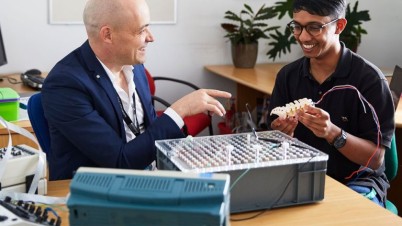
(L-R) Professor Greg O'Grady and Dr Chris Varghese
Gut disorders and diseases cause a vast burden of ill health and suffering both nationally and globally. Over 40% of New Zealand’s population are affected by gut disorders and conditions such as obesity, faecal incontinence, constipation, gastroparesis, and recovery from gastrointestinal surgery.
Since 2008, the HRC has provided funding to develop a novel, non-invasive diagnostic aid for gastric problems and to study many other gastrointestinal disorders and post-operative recovery. This work has been led by Professor Greg O’Grady, a gastrointestinal surgeon and the CEO and co-founder of the start-up medical device company Alimetry, along with bioengineer Dr. Armen Gharibans.
The team at Alimetry have developed a novel device (‘Gastric Alimetry’ system) worn over the stomach to measure the weak electrical signals produced by the gut, sending the data to an app. The electrophysiological results and the patient-reported symptoms in the app are analysed with artificial intelligence to help quickly and accurately diagnose various gastric disorders, and plan personalised treatment.
The technology can also be applied to aid recovery of gut function after surgical procedures on the gut, including for obesity and cancer.
“This non-invasive diagnostic approach represents a step change in the diagnostic pathway, suitable for millions of patients with gastric disorders.”
Manufactured in New Zealand, this system has now been exported to 10 countries and is used in more than 40 hospitals worldwide, representing a step change in the diagnostic pathway, suitable for millions of patients with gastric disorders.
Professor O’Grady says clinical uptake is expected to continue to accelerate and expand globally, including increasing impact in the field of paediatrics, as the FDA has recently expanded clearance for use in children over 12 years old and the system is now used in several leading US paediatric centres.
“Increased clinical uptake of Gastric Alimetry will have a large clinical impact and significant economic return for New Zealand from the commercialisation and export of the technology. There will also be significant cost-savings for the health system by reducing the need for unnecessary testing and hospital admissions,” says Professor O’Grady.
Since launching in 2019, Alimetry has brought in over $50 million in private investment capital from US, Australian and New Zealand investors. It is estimated that in New Zealand it may be possible to save over $1 million per year in reduced expenditures on admissions, bed-stays, tests and therapies. The number of innovative non-invasive techniques and inventions that have been protected has now grown to 46 patents internationally for Alimetry technologies.
HRC investment in this research stream has also contributed to the creation of a second spinout company to market the Insides System for adult intestinal failure and rehabilitation. The Insides Company has exported to 23 countries and treated over 1,000 patients with severe intestinal disorders, further contributing to capital investment, economic growth and employment.
The HRC is currently funding clinical feasibility research for a patented post-operative care device to monitor bowel leaks, the most serious complication following gastrointestinal surgery. Professor O’Grady and colleagues Dr Chris Varghese and Dr Cameron Wells also have HRC funding to see how they can use innovative continuous monitoring technology and artificial intelligence to help digitise New Zealand’s hospitals and potentially halve deaths after surgery.
The HRC has funded Professor O’Grady’s gastrointestinal research since 2008, starting with a Career Development Award to investigate a computer model of gastric electrical activity. Since then, Professor O’Grady has been the recipient of more than $11.5 million in HRC grant funding as first named investigator, including two consecutive Programme grants in 2018 and 2023, and an AI in Healthcare RFP grant in 2025.