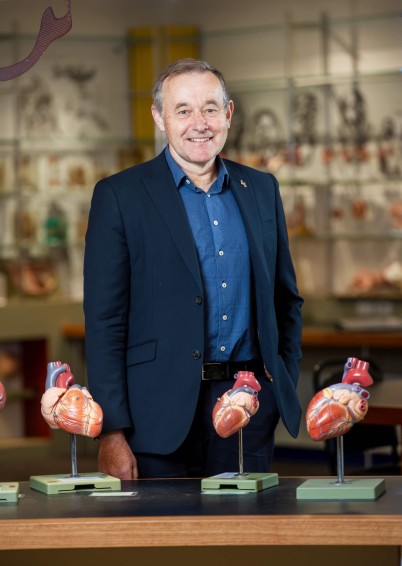
Professor Julian Paton
About 70 per cent of all patients with high blood pressure also have type 2 diabetes. Now, in a world first, the University of Auckland’s Professor Julian Paton and his research team have discovered a new way to lower blood pressure and blood glucose levels at the same time.
Through a five-year Health Research Council Programme Grant, Professor Paton and his team discovered that when a sensory organ called the carotid body, which is located next to the main arteries in the neck, becomes hyperactive it causes a person’s blood pressure to rise by activating nerves that constrict vessels and increase their heart rate. These are the same nerves that are activated in the fight-or-flight response and are called sympathetic nerves.
The carotid body, which is only about the size of a grain of rice, has been known for many years; however, it has traditionally been known for its role in sensing oxygen in the blood.
Professor Paton says this is the first time that it has been shown to also sense glucose.
Armed with this new knowledge, the team sought out a drug target to help calm the carotid body and in doing so lower blood pressure and blood glucose. They found it in the form of a drug called Gefapixant, which has recently been approved for treating patients with another condition, chronic cough.
To their amazement, the team discovered that Gefapixant acting on the carotid body not only controls blood pressure but also lowered levels of glucose. These pre-clinical results will be published later in 2026.
Professor Paton says this finding is very exciting and explains why so many people with high blood pressure also have high blood sugar (diabetes).
“We’ve shown that hypertension and type 2 diabetes are linked, which is something we’ve always suspected. The carotid body appears to be the common nodal point that potentially contributes to the manifestation of both these diseases and makes them worse.”
“While there are drugs that can treat a person’s high blood pressure or treat their diabetes, neither are particularly good, and it becomes so much harder to treat high blood pressure if you also have diabetes,” says Professor Paton.
“Our research has discovered for the first time a novel way to lower blood pressure and blood sugar. Dependent on a clinical trial, we believe Gefapixant could be the first drug to treat hypertension and diabetes simultaneously and as a result significantly improve patients’ wellbeing, saving billions of dollars in healthcare costs along the way.”
High blood pressure, which affects one-third of New Zealanders, is the number one modifiable risk factor causing heart attacks, strokes and kidney failure, yet it remains stubbornly hard to control. Professor Paton says about 50 percent of patients remain hypertensive despite being on high blood pressure medication, suggesting that the mechanisms driving their blood pressure are not being treated adequately.
“If you’re in a real fight-or-flight situation, you want your blood pressure to go up because that helps push more blood into your exercising muscles. You also want your blood sugar to go up because that generates more energy for your muscles. Normally after a fight-or-flight episode, your blood pressure and blood sugar will come down. However, if you’re hypertensive or diabetic, these markers will stay high almost as if you’re in a constant mode of fight or flight.”
Professor Paton says the Programme Grant has enabled his team to provide evidence showing that the current frontline medications for treating hypertension do not prevent the fight-or-flight response that activates the sympathetic nervous system activity and generates high blood pressure.
“Someone’s blood pressure can be controlled by frontline medication while they are quiet and relaxed. However, put them in their car, driving to a meeting they are late for and stuck in traffic, this stress will generate enormously high blood pressure by activating sympathetic nerves even if they are on blood pressure lowering medication,” says Professor Paton.
Subject to funding, the team hope to get a clinical trial underway to test the ability of Gefapixant to lower blood pressure, blood glucose and sympathetic nerve activity in patients with hypertension and type 2 diabetes. They are also working on a DNA screening test to identify the drug type that will best lower a patients’ blood pressure as currently the choice of drug is made empirically.
This research was funded by a 2019 five-year HRC Programme Grant of $4.9 million.
Useful links:
https://www.translationalcardiorespiratory.auckland.ac.nz/people/
Felippe et al. (2026). Vitamin B6 (Pyridoxal 5′ Phosphate) antagonises carotid body P2X3 receptors in hypertension. https://academic.oup.com/cardiovascres/article/122/2/285/8287249?login=false
Pauza et al. (2025). Melanocortin system activates carotid body arterial chemoreceptors in hypertension https://doi.org/10.1161/CIRCRESAHA.125.326394
Sayegh et al. (2025). Peripheral chemoreflex restrains skeletal muscle blood flow during exercise in participants with treated hypertension https://physoc.onlinelibrary.wiley.com/doi/10.1113/JP286998
Thakkar et al. (2023). Carotid body: an emerging target for cardiometabolic co-morbidities https://pmc.ncbi.nlm.nih.gov/articles/PMC10988524/
Pauza et al. (2022). GLP1R attenuates sympathetic response to high glucose via carotid body inhibition. https://pmc.ncbi.nlm.nih.gov/articles/PMC8893134/